
Flood cleanup in Pittsburgh, PA
Flood cleanup in Pittsburgh covers outside water that got into the house: a creek over its banks, runoff pouring down a hillside street, or river water near the Point. Outside water is treated as contaminated, standard homeowners policies leave it out, and drying can't start until the water is pumped out and wet walls are opened.
Your call is connected with an independent local company. Water category: category 3 (contaminated): flood water from outside.
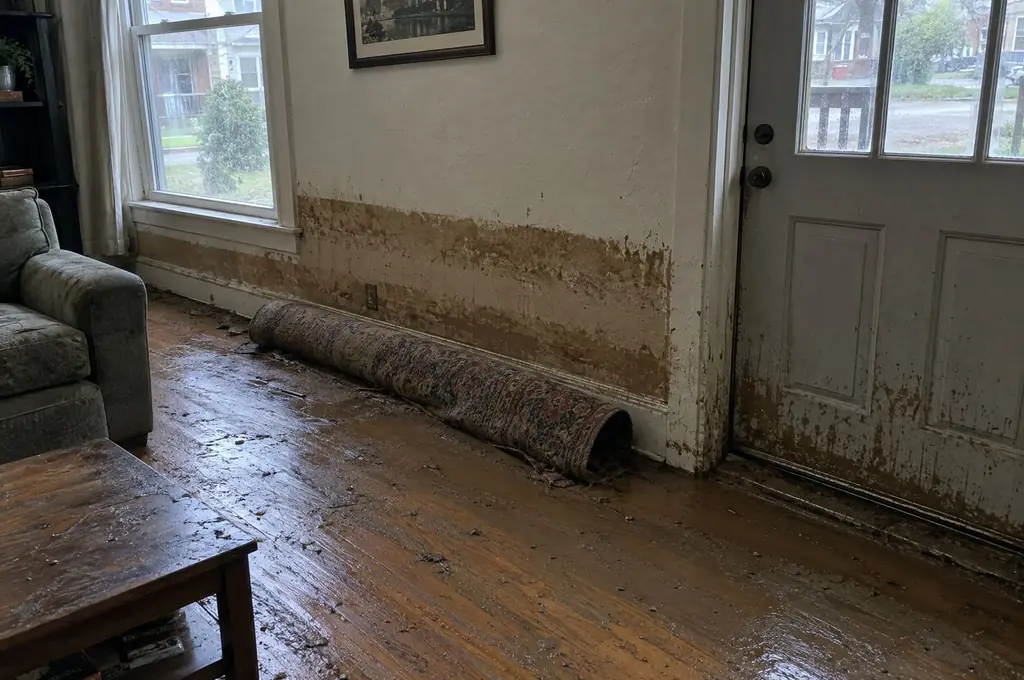
Illustrative photo.
Flash flooding here usually comes from short, heavy bursts of rain on steep, paved ground. On Aug. 19, 2011 about 2.5 inches fell in under an hour east of downtown and Washington Boulevard filled within minutes. In Carrick and Overbrook, the City and Pittsburgh Water are building new storm sewers on Stewart Avenue because runoff there flows toward homes.
Right now
- 1Don't walk or drive through moving water. The National Weather Service warns that 6 inches of fast-moving water can knock you off your feet.
- 2Keep children and pets out of flood water; treat it as contaminated.
- 3Turn off power at the panel only if you can reach it from a dry spot.
- 4Photograph the water line on walls and furniture for your records before cleanup starts.
- 5Look up your address on FEMA's flood map so you know your zone when you talk to your insurer.
Pittsburgh facts for this problem
The remnants of Hurricane Ivan dropped 5.95 inches on Pittsburgh on Sept. 17, 2004, first on NWS Pittsburgh's list of tropical storm rain totals.
Source: NWS Pittsburgh: Hurricane and Tropical Storm Rainfall in Pittsburgh.
NCEI's storm record for Sept. 17, 2004 counts 9,494 homes damaged or destroyed in Allegheny County, where 62 of 130 municipalities declared an emergency.
On Aug. 19, 2011 about 2.5 inches of rain fell in under an hour east of downtown, and flash flooding on Washington Boulevard killed four people (NCEI, from an NWS survey).
The Ohio River at Pittsburgh's record crest is 46.0 feet on March 18, 1936; the National Weather Service's flood stage there is 22 feet.
Source: NWS: Ohio River at Pittsburgh (PTTP1), flood categories, impacts and crest history.
Pennsylvania's Insurance Department says more than 40 percent of flood insurance claims come from outside high-risk areas.
Source: PA Insurance Department: Learn About Flood Insurance.
FEMA records 2,330 NFIP flood claims in the 42 ZIP codes this site serves, with $40,306,435 paid on buildings and contents.
Source: FEMA OpenFEMA NFIP Redacted Claims v3, calculated by Pittsburgh Water Damage & Mold on November 13, 2026.
Claims with a 2004 date of loss, the year of Frances and Ivan, number 695 in those ZIPs, with $20,983,931 paid.
Source: FEMA OpenFEMA NFIP Redacted Claims v3, calculated by Pittsburgh Water Damage & Mold on November 13, 2026.
Pennsylvania's Insurance Department calls flooding the state's most common natural disaster and says more than 40 percent of flood insurance claims come from outside high-risk areas. Standard homeowners policies leave flood out. Look up your address on FEMA's flood map before you talk to anyone about coverage.
Sources: PA Insurance Department: Learn About Flood Insurance; FEMA Flood Map Service Center
Related on this site: the Pittsburgh flooding history for river crests and flash floods back to 1936, and the flood claims by ZIP for NFIP flood claims in each Pittsburgh ZIP.
How the work usually goes
Pump out and muck out
Water and silt come out first, then anything porous that sat in flood water.
Flood cut
Drywall and insulation are usually cut out above the water line so the wall cavity can be cleaned and dried.
Clean and disinfect
Framing, subfloor and concrete are cleaned and treated before drying equipment goes in.
Dry and verify
Dehumidifiers and air movers run until materials read dry, which takes longer in basements and older plaster homes.
Records for you
Photos, a written list of what was removed and daily moisture readings, for your records and your insurer.
How insurance usually treats it
Water that comes in from outside, over the ground, is flood under insurance terms, and Pennsylvania's Insurance Department says standard homeowners and renters policies don't cover it. Flood coverage comes from a separate flood policy through the National Flood Insurance Program or a private insurer.
General information, not insurance advice. Your policy decides. See Pennsylvania water damage insurance rules.
What changes the size of the job
- Depth of the water and how many rooms it reached
- Silt and mud removal
- How far up the walls have to be cut
- Contents that have to be removed and listed
- Days of drying, which run longer in basements
We don't quote prices. A company measures moisture on site and writes an itemized estimate; the water damage estimator lists what that estimate should include.
Questions people ask
Is my Pittsburgh house in a flood zone?
Look up your address on FEMA's Flood Map Service Center. Pennsylvania's Insurance Department notes that more than 40 percent of flood insurance claims come from outside high-risk areas, so a moderate or low zone doesn't mean water can't reach you.
Does homeowners insurance cover flood water in Pennsylvania?
No. The Pennsylvania Insurance Department lists flood as a common exclusion in homeowners policies. Flood damage is covered by a separate flood policy.
How high has the river gotten at Pittsburgh?
The Ohio River gauge at Pittsburgh's record crest is 46.0 feet on March 18, 1936. Hurricane Ivan's remnants brought it to 31.0 feet on Sept. 18, 2004, and it reached 28.37 feet on April 4, 2024. The National Weather Service's flood stage there is 22 feet.
Sources for this page
- PA Insurance Department: Learn About Flood Insurance
- PA Insurance Department: Homeowners Insurance
- FEMA Flood Map Service Center
- NOAA NCEI Storm Events Database (bulk files)
- City of Pittsburgh: Stewart Avenue stormwater project (Aug 25, 2026)
- NWS: Ohio River at Pittsburgh (PTTP1)
- NWS Pittsburgh: Floods preparedness guide