
Burst and frozen pipe water damage in Pittsburgh
When a burst or frozen pipe floods a Pittsburgh house, close the main valve where the water line comes in, then call. Pittsburgh Water owns the line up to and including the curb box; past it, the line to the meter and every pipe inside are yours. Clean water dried within a day or two means less tear-out.
Your call is connected with an independent local company. Water category: category 1 (clean supply water) when drying starts within a day or two.
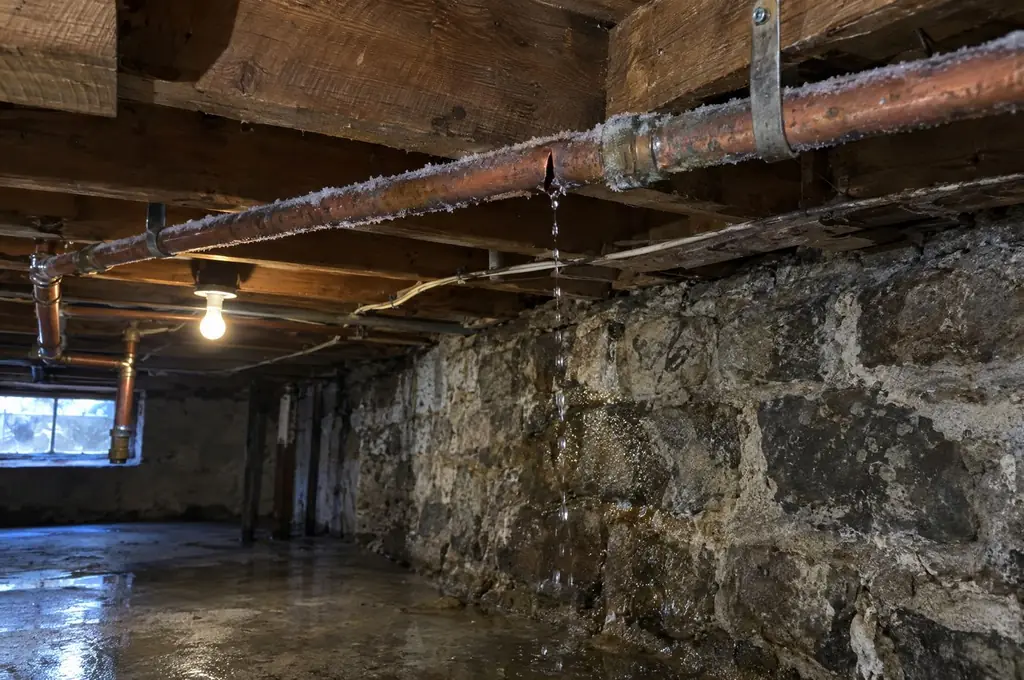
Illustrative photo.
Most bursts follow a hard freeze: water freezes in a pipe on an outside wall, under a back addition or in an unheated porch, pressure builds behind the ice, and the pipe splits. It often isn't noticed until the thaw, when water starts moving again. The live weather page flags nights forecast at or below 20°F.
Right now
- 1Close the main valve. If it won't turn, call Pittsburgh Water at 412-255-2423 and press 1; it can shut water at the curb box.
- 2Open a faucet on the bottom floor to drain pressure from the pipes.
- 3Stay out of rooms where water is near outlets or a ceiling sags. Switch off that circuit only from a dry floor.
- 4Take photos of the split pipe and every wet area for your records before you move anything.
- 5Call a plumber for the pipe and a water damage company for the drying. Drying shouldn't wait for the repair.
Pittsburgh facts for this problem
Pittsburgh Water's 24/7 emergency dispatch is 412-255-2423, press 1.
Source: Pittsburgh Water: Contact Us.
For homes, Pittsburgh Water is responsible for the water line from the main up to and including the curb box; from the curb box to the meter the line belongs to the property owner.
Source: Pittsburgh Water: Pipe Ownership.
Freezing in unprotected pipes begins when the outdoor temperature drops to 20°F, according to research cited by the International Code Council.
Source: International Code Council eNews, citing the Insurance Institute for Business & Home Safety.
Over the last 30 winters the Pittsburgh station averaged 37 nights at or below 20°F a winter.
Source: ACIS daily record, Pittsburgh Area record (NWS climate site, kept at Pittsburgh International Airport today), calculated by Pittsburgh Water Damage & Mold on November 13, 2026.
Last winter (2025-26) had 48 nights at or below 20°F at the station, and the coldest reached -11°F.
Source: ACIS daily record, Pittsburgh Area record (NWS climate site, kept at Pittsburgh International Airport today), calculated by Pittsburgh Water Damage & Mold on November 13, 2026.
Pittsburgh Water says its mains average about 80 years old, more than 40 percent were laid before 1920, and breaks are more likely in winter.
Source: Pittsburgh Water: How Do Emergency Water Main Repairs Work? (Oct 2025).
The median home in ZIP 15201, 15203, 15207, 15208, 15210, 15211, 15212, 15216, 15217, 15224, 15233 was built in 1938, the oldest median among the city's ZIP codes (Census ACS 5-year).
Source: U.S. Census Bureau, ACS 5-year, tables B25034 and B25035, calculated by Pittsburgh Water Damage & Mold on November 13, 2026.
Pittsburgh Water's line is 412-255-2423, press 1, around the clock. It owns the service line from the main up to and including the curb box in the sidewalk. From the curb box to your meter, the pipe and any leak on it belong to the property owner.
Sources: Pittsburgh Water: Contact Us; Pittsburgh Water: Pipe Ownership
Related on this site: the Pittsburgh rainfall and freeze watch for tonight's low against the 20°F freeze line, and the water main break guide for who owns the pipe from the street to your meter.
How the work usually goes
Map the moisture
Meters and a thermal camera trace how far the water traveled inside walls, under hardwood and down into the basement ceiling.
Extract
Standing water comes out of carpet, pad and subfloor so the drying equipment can do its job.
Open only what has to open
Wet insulation and swollen trim usually come out. Plaster and lath hold water longer than drywall, so the company should explain what it will remove and why.
Dry and take readings
Dehumidifiers and air movers run until every material reaches its dry reading, usually checked daily.
Records for you
Photos, daily moisture readings and an itemized estimate go to you, so you can see what was wet and what was done.
How insurance usually treats it
A pipe that bursts suddenly is usually covered under a standard homeowners policy, including drying and the tear-out needed to reach the leak. The broken pipe itself often isn't. Freeze damage can be excluded when a house was left without heat and the water wasn't shut off and drained, so read the freezing section of your policy.
General information, not insurance advice. Your policy decides. See Pennsylvania water damage insurance rules.
What changes the size of the job
- How long water ran before the main was closed
- How many floors and rooms it reached
- Plaster and lath versus drywall, and hardwood versus carpet
- How much material has to come out to dry the cavity
- How many days the drying gear runs, and how many units
We don't quote prices. A company measures moisture on site and writes an itemized estimate; the water damage estimator lists what that estimate should include.
Questions people ask
At what temperature do pipes freeze in Pittsburgh?
Research from the Insurance Institute for Business & Home Safety, published by the International Code Council, puts the start of freezing in unprotected pipes at an outdoor temperature of 20°F. Our weather page flags any night in the next two days forecast at or below that.
Who fixes a leak between the curb box and my house?
You do. Pittsburgh Water's pipe ownership page says its responsibility runs from the main to and including the curb box. The line from the curb box to the meter belongs to the property owner, so that repair goes to a plumber you hire.
Can plaster walls be dried in place after a burst pipe?
Often, if the water was clean and drying starts quickly. Plaster holds moisture longer than drywall, so readings should continue until it reaches its dry standard before anyone repaints or closes cavities.