
Basement flooding and sewer backup cleanup in Pittsburgh
Basement flooding in Pittsburgh comes three ways: a storm overloads the combined sewer and pushes water up a floor drain, groundwater or snowmelt seeps through the walls, or a pipe breaks. Sewer backup water is contaminated. Stay out of it, call Pittsburgh Water at 412-255-2423 (press 1), then arrange cleanup.
Your call is connected with an independent local company. Water category: category 3 (contaminated) for sewer backups and outside water; category 1 or 2 for a supply line.
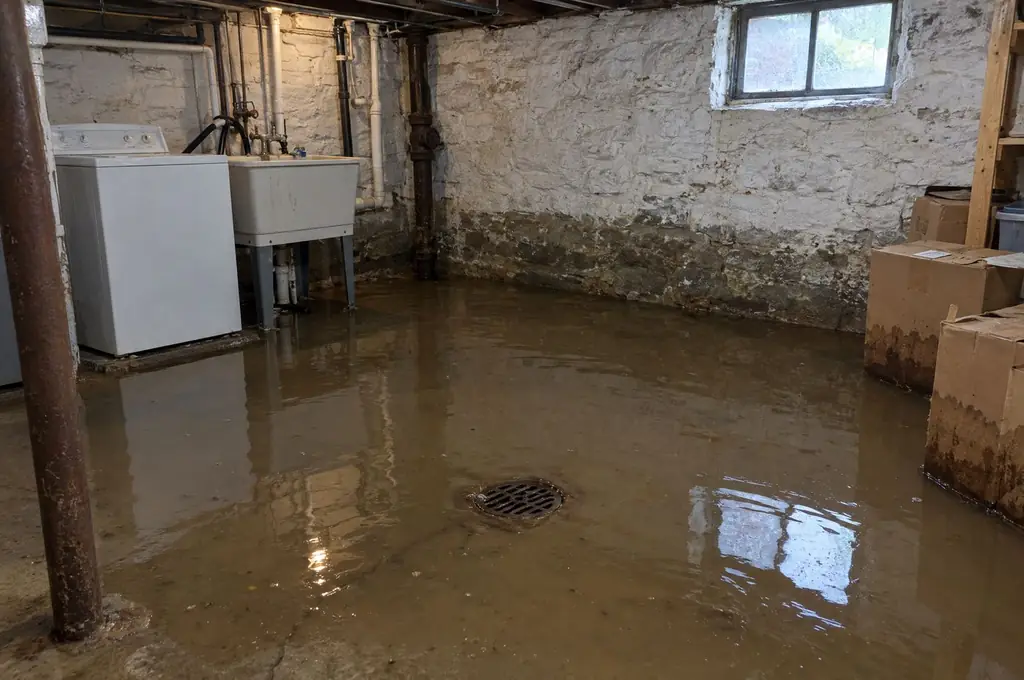
Illustrative photo.
Pittsburgh Water says about 75 percent of the city has combined sewers that carry sewage and storm runoff in the same pipes. In a heavy storm those pipes fill and the mix rises toward the openings closest to the ground, often a basement floor drain. When that happens and the water drains once the rain stops, the utility says cleanup is the owner's responsibility.
Right now
- 1Keep children and pets away. Don't wade into water that came up from a drain.
- 2If sewage is pooling, call Pittsburgh Water at 412-255-2423 and press 1. A crew checks whether the problem is in its main or in your lateral.
- 3Stop running water, flushing toilets and doing laundry until the drain clears.
- 4Don't touch the furnace, water heater or outlets if water is around them. Switch power off from a dry spot or wait for help.
- 5Photograph the water level and the drain for your records before it is pumped out.
Pittsburgh facts for this problem
About 75 percent of Pittsburgh is served by combined sewers that carry sewage and stormwater in the same pipes.
When combined sewers are overwhelmed, Pittsburgh Water says combined sewage can back up into basements.
The whole sewer lateral, from the house to the main, is the property owner's responsibility; Pittsburgh Water maintains the main and the wye where they join.
Source: Pittsburgh Water: Pipe Ownership.
If a backup happens during heavy rain and drains when the storm ends, Pittsburgh Water says cleanup is the property owner's responsibility.
Source: Pittsburgh Water: Flood Preparedness.
Pittsburgh Water's snowmelt advice is to keep snow piles away from the foundation and extend downspouts a few feet out to keep water out of basements.
Source: Pittsburgh Water: When Winter Weather Warms (Feb 2026).
The Pittsburgh record has 121 days since 2000 with 1.17 in. of rain or more, the wettest 1% of days on record.
Source: ACIS daily record, Pittsburgh Area record (NWS climate site, kept at Pittsburgh International Airport today), calculated by Pittsburgh Water Damage & Mold on November 13, 2026.
If sewage is pooling in your basement, Pittsburgh Water asks you to call 412-255-2423 and press 1. A crew decides whether the clog or break is in its main or in your lateral. The lateral is the owner's, and so is the cleanup when a storm overloads the combined sewer and the backup drains once the rain ends.
Sources: Pittsburgh Water: Flood Preparedness; Pittsburgh Water: Pipe Ownership; Pittsburgh Water: Combined Sewer System
Related on this site: the Pittsburgh flooding history for the heavy rain days that overload combined sewers, and the Pennsylvania water damage insurance guide for when a sewer backup is covered.
How the work usually goes
Find the source
A storm backup, a blocked or broken lateral, seepage and a broken pipe each lead to different repairs and different coverage, so the source gets written down first.
Pump out and remove
Water is extracted, and porous items soaked by sewage, like carpet, pad, drywall and cardboard, are usually removed and bagged.
Clean and disinfect
Floors, walls and anything that stays are cleaned and treated before drying starts.
Dry below grade
Basements dry slower than rooms above ground, so dehumidifiers run until concrete, block and framing reach normal readings.
Plan the prevention
The company may suggest a plumber camera the lateral or look at a backwater valve. That is separate work you can price on its own.
How insurance usually treats it
A base homeowners policy usually covers a sudden pipe break in the basement. Water that backs up through a drain is usually excluded unless the policy has a water backup endorsement, which often has its own limit. Groundwater seepage and outside flood water are generally covered only by a flood policy.
General information, not insurance advice. Your policy decides. See Pennsylvania water damage insurance rules.
What changes the size of the job
- Whether the water was sewage, groundwater or clean supply water
- How much of the basement is finished
- Carpet, pad, drywall and stored belongings that have to go
- How long the water sat before pumping started
- Days of below-grade drying
We don't quote prices. A company measures moisture on site and writes an itemized estimate; the water damage estimator lists what that estimate should include.
Questions people ask
Who pays when the sewer backs up into my Pittsburgh basement?
It depends on where the problem is. Pittsburgh Water maintains the sewer main and the joint where your lateral meets it. The lateral itself is the owner's. After a storm backup that drains when the rain stops, the utility says cleanup falls to the property owner.
Why does my basement drain back up only when it rains?
In about three quarters of Pittsburgh, storm runoff and sewage share the same pipes. A heavy storm can fill them faster than they drain, and the overflow comes up through the drains closest to the ground, often in basements.
Can carpet be saved after a sewage backup?
Usually not. Carpet and pad soaked by sewage are treated as contaminated and are normally removed. Hard surfaces like concrete and tile are cleaned and disinfected instead.
Does snowmelt cause basement leaks in Pittsburgh?
It can. Pittsburgh Water warns that snow piled against the foundation can seep into the basement as it melts, and suggests extending downspouts a few feet out and keeping snow away from the walls.